
Keywords
thrombosis
direct oral anticoagulants
How to Cite


Abstract
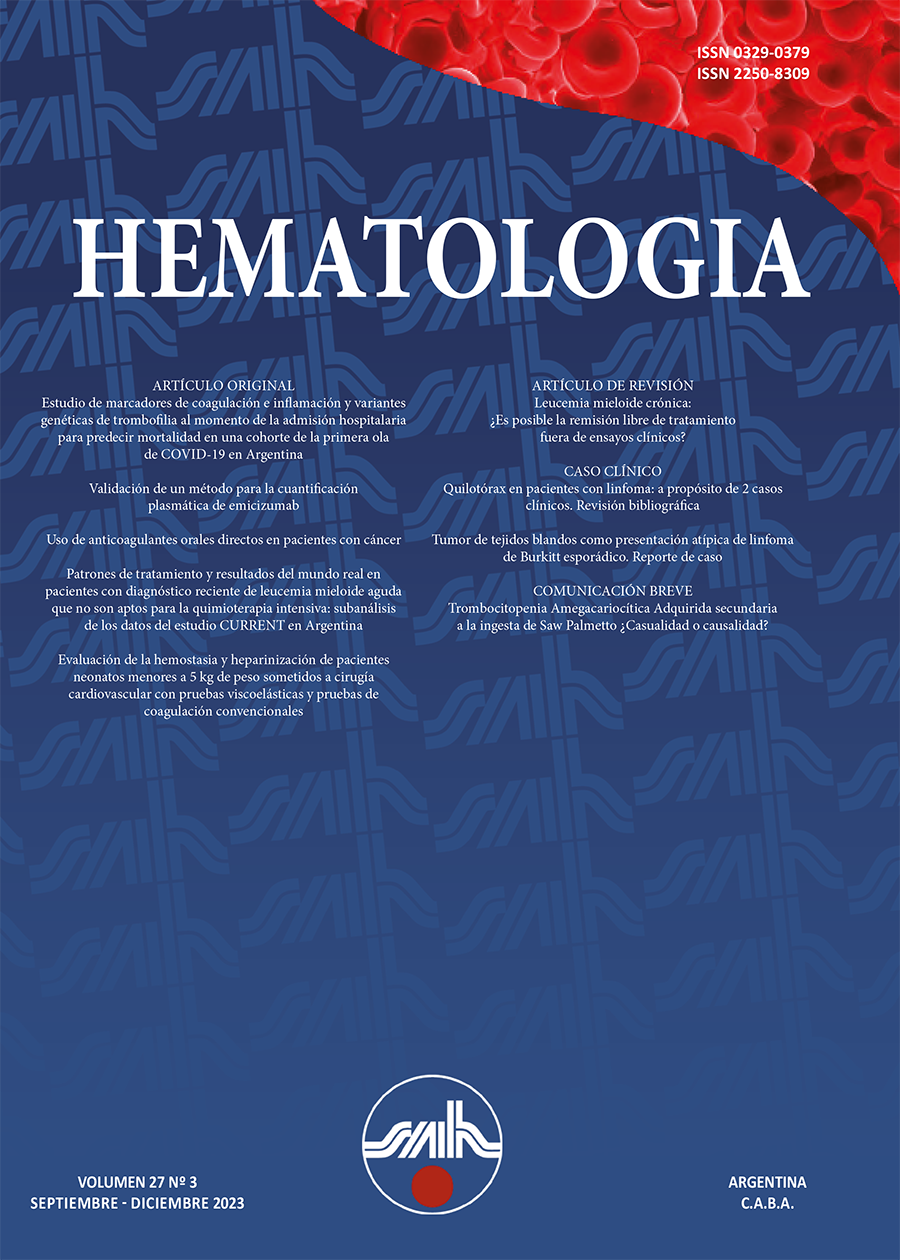
Introduction: The appearance of thromboembolic events is a frequent complication in cancer patients. It is a population that is difficult to treat because it has a higher prevalence of recurrent thrombosis with an annual risk of occurrence of 20%; and hemorrhages with an annual risk of occurrence of 12%. Aims: to describe our population with thrombosis and cancer on DOACs (rivaroxaban and apixaban) at Clínica Universitaria Reina Fabiola. To identify bleeding complications, major bleeding (MB) and clinically relevant non-major bleeding (CNRMB). To identify recurrent thrombosis. Materials and methods: retrospective descriptive study. People over 18 years of age with active cancer and venous thromboembolism on treatment with direct oral anticoagulants (DOACs): rivaroxaban and apixaban. Patients with thrombosis in unusual sites were included. Results: The population was 49 patients. 61% were female, and the average age was 60 years. The average number of days of anticoagulant treatment that each patient received was 314 days. The primary tumor site was: 21% of cases breast (n 10), 14% (n 7) gastrointestinal tract tumors and 14% (n 7) lung tumors. Other locations were: kidney, melanoma, gallbladder, prostate, bladder, pancreas, lymphoma, myeloma, central nervous system. 16% of patients presented CNS involvement (2% (n 1) glioblastoma, 14% (n 7) brain metastases). Regarding oncological therapy, 12 patients (25%) received target therapy, 24 patients (50%) monoclonal antibodies, 27 patients (55%) traditional chemotherapy, 2 patients received immunomodulatory drugs, 1 patient received only surgical treatment and 2 patients added radiotherapy. During treatment, 14 (28.5%) patients received dose reduction of the anticoagulant drug. Of the remaining subpopulation of 35 patients, 7 cases (20%) of the patients presented episodes of intratreatment thrombosis and 8 patients (23%) presented episodes of hemorrhage (9% SM and 14% SCR). Discussion: Compared to the literature, our population presented a higher percentage of recurrent thrombosis as well as bleeding. No statistically significant relationship was found between the type of anticoagulant, tumor location, the presence of metastasis in the central nervous system, extreme weight, alteration of kidney or liver function or the type of oncological treatment received. Conclusion: Major rates of recurrent thrombosis and bleeding were associated with DOACs treatment in our cancer patients. Larger numbers of patients are needed to determine the safety and efficacy of DOACs in real-life oncology patients (excluded from clinical trials).
References
Maneyro AJ. Trombosis y cáncer. Número Extraordinario XIII Congreso del Grupo CAHT. 2018; Vol 22: 311-315.
Noble S, Pasi J. Epidemiology and pathophysiology of cancer-associated thrombosis. Br J Cancer. 2010; 102 Suppl 1: S2-9.
Raskob GE, van Es N, Verhamme P, Carrier M, Di Nisio M, Garcia D, Grosso MA, Kakkar AK, Kovacs MJ, Mercuri MF, Meyer G, Segers A, Shi M, Wang TF, Yeo E, Zhang G, Zwicker JI, Weitz JI, Büller HR; Hokusai VTE Cancer Investigators. Edoxaban for the Treatment of Cancer-Associated Venous Thromboembolism. N Engl J Med. 2018 Feb 15;378(7):615-624. doi: 10.1056/NEJMoa1711948. Epub 2017 Dec 12. PMID: 29231094.
Young AM, Marshall A, Thirlwall J, et al: Comparison of an oral factor Xa inhibitor with low molecular weight heparin in patients with cancer with venous thromboembolism: Results of a randomized trial (SELECT- D). J Clin Oncol 36:2017-2023, 2018
Agnelli G, Becattini C, Bauersachs R, et al. Apixaban versus dalteparin for the treatment of acute venous thromboembolism in patients with cancer: the Caravaggio Study. Thromb Haemost 2018 Sep;118(9):1668- 1678.
Carney BJ, Uhlmann EJ, Puligandla M, et al: Intracranial hemorrhage with direct oral anticoagulants in patients with brain tumors. J Thromb Haemost 17:72-76, 2019
Kaatz S, Ahmad D, Spyropoulos AC, Schulman S, for the Subcommittee on Control of Anticoagulation. Definition of clinically relevant non-major bleeding in studies of anticoagulants in atrial fibrillation and venous thromboembolic disease in non-surgical patients: communication from the SSC of the ISTH. J Thromb Haemost 2015; 13: 2119–26
Venous Thromboembolism Prophylaxis and Treatment in Patients With Cancer: ASCO Clinical Practice Guideline Update
Farge D, Frere C, Connors, J, y col. The International Initiative on Thrombosis and Cancer (ITAC) advisory panel. Lancet Oncol. 2022; Vol 23:334–47. DOI: 10.1016/S1470-2045(22)00160-7.
2020; 382: 1599–607. 10 Planquette B, Bertoletti L, Charles-Nelson A, et al. Rivaroxaban versus dalteparin in cancer-associated thromboembolism: a randomized trial. Chest 2022; 161: 781–90. 11
Schrag D, Uno H, Rosovsky RPG, et al. The comparative effectiveness of direct oral anti-coagulants and low molecular weight heparins for prevention of recurrent venous thromboembolism in cancer: the CANVAS pragmatic randomized trial. Proc Am Soc Clin Oncol 2021; 39 (suppl 15): 12020 (abstr)
Li A, Garcia DA, Lyman GH, et al: Direct oral anticoagulant (DOAC) versus low-molecular-weight heparin (LMWH) for treatment of cancer associated thrombosis (CAT): A systematic review and meta-analysis. Thromb Res 173:158-163, 2019.
Brunetti ND, Gesuete E, De Gennaro L, et al: Direct oral anti-coagulants compared with vitamin-K inhibitors and low-molecular-weight-heparin for the prevention of venous thromboembolism in patients with cancer: A meta-analysis study. Int J Cardiol 230:214-221, 2017.
Screening for clinically relevant drug-drug interactions between direct oral anticoagulants and antineoplastic agents: a pharmacovigilance approach Bang Truong 1, Lori Hornsby 2, Brent I Fox 1, Chiahung Chou 1, Jingyi Zheng 3, Jingjing Qian.
All material published in the journal HEMATOLOGÍA (electronic and print version) is transferred to the Argentinean Society of Hematology. In accordance with the copyright Act (Act 11 723), a copyright transfer form will be sent to the authors of approved works, which has to be signed by all the authors before its publication. Authors should keep a copy of the original since the journal is not responsible for damages or losses of the material that was submitted. Authors should send an electronic version to the email: revista@sah.org.ar